Why Managing Interest-Rate Risk Comes Down to Judgement, Not Just Maths
Every bank borrows on one set of terms and lends on another, and the two rarely move in step. When interest rates shift, as they have sharply in recent years, the gap between what a bank owes and what it earns can open quickly. Managing that gap well is unglamorous work, yet getting it wrong has undone more than one institution.
This was the focus of the second session in UBA UK’s Treasury Management Series, delivered by Professor Moorad Choudhry, one of the most respected figures in bank treasury. Here is what stood out.
What Makes Interest-Rate Risk Difficult to Manage?
Not the maths. Measuring interest-rate risk is, at its core, straightforward arithmetic. The real difficulty lies in holding clean, accurate data on what a bank owns and owes, and in exercising sound judgement about what the figures mean. The global rulebook governing this area was written a decade ago, yet banks continue to debate how best to apply it, because it deliberately leaves room for institutional judgement rather than a single prescribed answer.
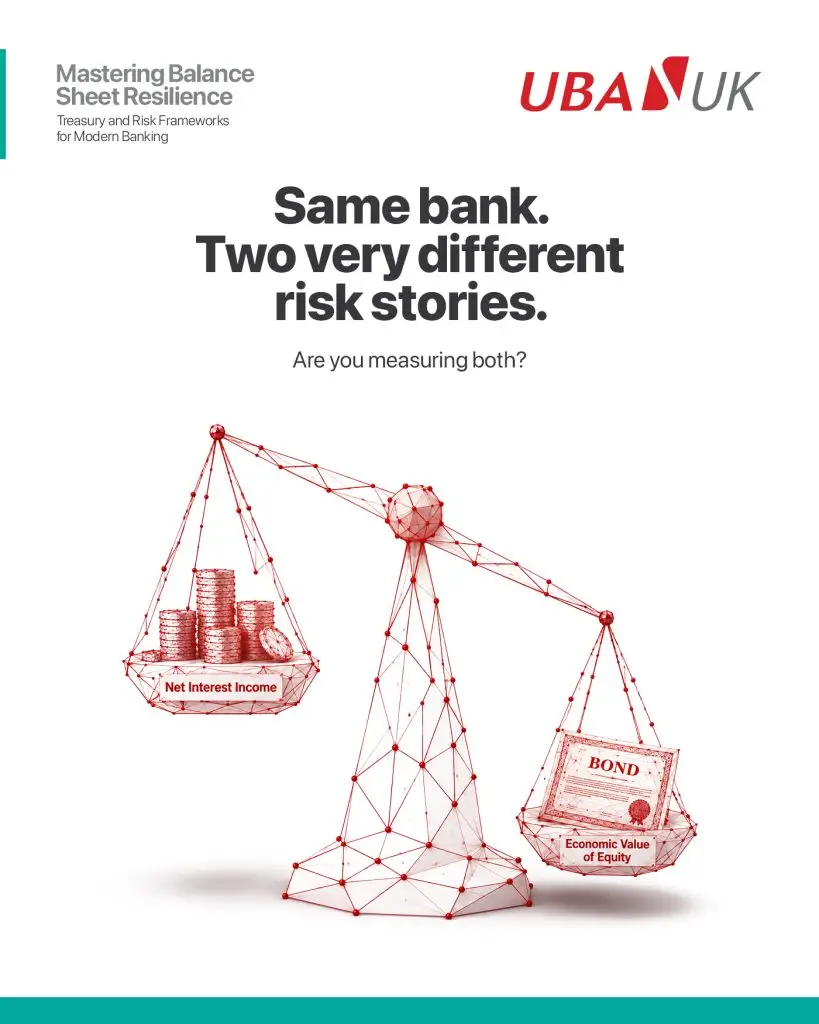
What Are the Two Ways Banks Measure Interest-Rate Risk?
Banks assess exposure through two lenses: earnings and value. The earnings view asks how income might shift over the next twelve months, a horizon Professor Choudhry favours since longer forecasts lose reliability. The value view asks what today’s balance sheet would be worth if rates moved, a snapshot valid only for that moment.
These two views usually align. When they don’t, a decision that protects near-term earnings can weigh on underlying value, or vice versa. There is no formula to settle the disagreement; it falls to a bank’s asset and liability committee to decide, and that decision is where the real work of treasury management lives.
Why Do Standard Stress Tests Understate Real Risk?
Because they assume a scenario that has never actually happened. Standard stress tests often model rates moving by the same amount across all maturities, a tidy parallel shift. In practice, short and long-term rates rarely move together, and sometimes move in opposite directions. A bank that tests only against the neat scenario can appear well protected on paper while carrying real exposure. Professor Choudhry’s discipline was clear: never rely on the parallel shift alone; always test against a more realistic, uneven movement too.
When Earnings and Value Disagree, Which Should a Bank Protect?
Professor Choudhry’s view is earnings, though he acknowledged this is genuinely contested among practitioners. Earnings are real cash; a fall in income cannot be recovered. The value view is a useful estimate, but one that shifts daily and carries no immediate cost. His instinct, therefore, is to steady earnings first, structuring the balance sheet to perform consistently regardless of which way rates move, rather than taking a view on rate direction. The goal is resilience to being wrong, not confidence in being right.
What Should Every Board Balance-Sheet Review Include?
One summary slide, reviewed at the start and end of every meeting, showing both risk measures against the bank’s agreed limits, alongside capital, liquidity and lending margins. The value isn’t the slide itself, but the habit it enforces. Risk that is visible against a clear limit can be managed before it becomes a problem; risk left in a spreadsheet tends to surface only after it has already cost something.
The Bigger Lesson
Interest-rate risk is often treated as a technical, back-office matter for specialists and their models. Professor Choudhry’s argument runs the other way: the calculations are the easy part. The real value lies in judgement – knowing which scenarios to take seriously, which measure to trust when they diverge, and keeping the full picture visible to decision-makers.
That philosophy sits close to our own. UBA UK connects global financial institutions to opportunities across Africa, and disciplined balance-sheet management underpins that role. Sessions like this are part of how we and our partners continue to sharpen it.
You can watch the full session recording below.
The next session in our Treasury Management Series, on Artificial Intelligence and Bank Balance Sheet Management, takes place on 30 July 2026, click here to register. To learn more about UBA UK or explore opportunities with us, please get in touch with our team at businessdevelopment@ubauk.com
 UK
UK Nigeria
 Benin
Benin Burkina Faso
 Cameroon
 Tchad
Tchad
 RDC
RDC Cote d'ivoire
 Gabon
Gabon Ghana
Ghana Guinea
 Kenya
Kenya Liberia
 Moçambique
 Senegal
 Sierra Leone
 Tanzania
 Uganda
 Zambia
 France
 America
 Mali
Mali UAE
UAE France